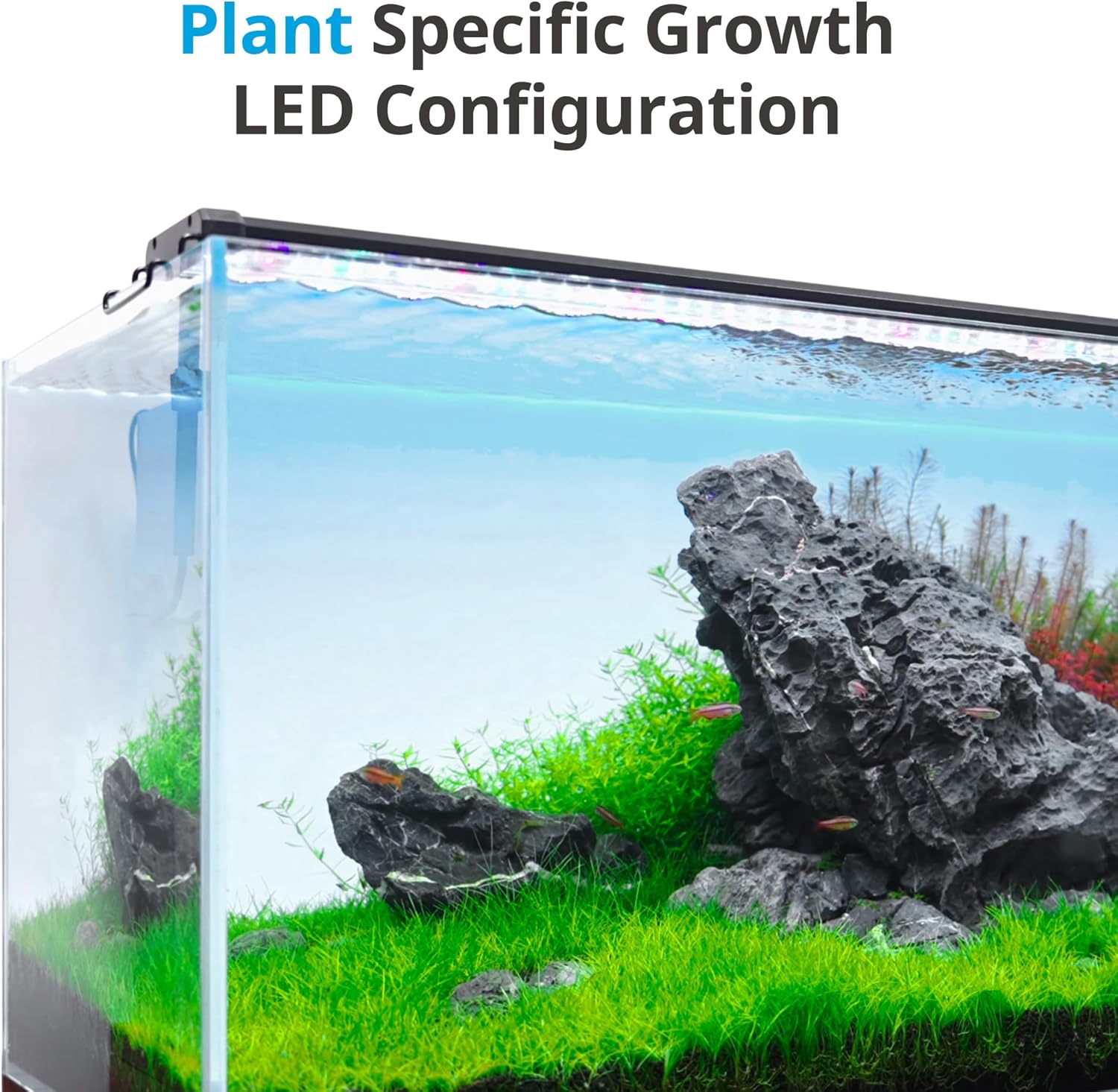
If you’ve ever watched a beautifully planted aquarium online and then looked at your own tank — where the plants are slowly turning yellow and melting away — the problem is almost always light. Not the fish, not the fertilizer, not even the water. Light. A planted tank is essentially a miniature garden submerged in water, and just like the garden outside, the plants inside need the right kind of light, at the right intensity, for the right amount of time each day. “Light intensity” in the aquarium world is typically measured in PAR — short for Photosynthetically Active Radiation — which is a measure of how much usable light energy actually reaches your plants’ leaves. This guide will walk you through exactly what that means, which fixtures deliver it well, and how to set a timer schedule that drives real plant growth without accidentally triggering an algae explosion.
Whether you just set up your first planted tank or you’re rebuilding a 75-gallon Dutch-style layout from scratch, the framework here is the same. We’ll cover spectrum, PAR targets by plant type, fixture selection across budget tiers, and the photoperiod math that keeps algae at bay.
| EDITOR'S PICK[hygger Advanced Remote Control…](https://www.amazon.com/dp/B09T3C4N99?tag=greenflower20-20) | Mid-tier[hygger Auto On Off LED Aquarium…](https://www.amazon.com/dp/B09B242PLL?tag=greenflower20-20) | Budget pick[NICREW ClassicLED Plus LED Aqua…](https://www.amazon.com/dp/B0B6ZMCQMZ?tag=greenflower20-20) | |
|---|---|---|---|
| Wattage | 58W | — | 21W |
| Spectrum Type | Full Spectrum | Full Spectrum | — |
| Tank Length | 48~54" | 48-55" | 30-36" |
| Control Type | Remote | Auto On/Off | Timer |
| Price | $99.99 | $71.24 | $48.99 |
| See on Amazon → | See on Amazon → | See on Amazon → |
Why “Bright” Isn’t the Same as “Plant-Ready”
This is the trap most beginners fall into: they buy a fixture that looks bright to the human eye and assume the plants will love it. But plants don’t photosynthesize with the same sensitivity range as human vision. They need specific wavelengths — primarily in the blue (450–470 nm) and red (640–680 nm) bands — to drive the chlorophyll reactions that produce growth.
As Aquatic Plant Central’s lighting basics documentation explains, a light can appear intensely white or even blue-white to our eyes while delivering almost nothing in the red band that low-tech stem plants and carpeting foreground species depend on. This is why “watts per gallon” — the old rule of thumb that said you need 2–4 watts of light per gallon of tank water — has been largely retired. Watts measure power consumption, not usable photon delivery. PAR, measured in micromoles per square meter per second (μmol/m²/s), is the number that actually predicts growth.
The practical takeaway: When you’re evaluating any fixture, ask whether the manufacturer publishes a PAR map — a grid of readings taken at multiple depths and horizontal positions in a tank of a specific dimension. Fixtures without published PAR data are a black box for plant growth planning.
PAR Targets by Plant Category
Not all plants need the same intensity. This is one of the most useful frameworks you can internalize, because it lets you match your fixture choice to your stocking list — rather than buying the most powerful light and hoping for the best.
By the numbers — PAR targets for common planted tank categories:
| Plant Category | PAR at Substrate | Examples |
|---|---|---|
| Low-light / shade-tolerant | 15–30 μmol/m²/s | Anubias, Java fern, Cryptocoryne |
| Medium-light | 30–70 μmol/m²/s | Vallisneria, Amazon sword, most stem plants |
| High-light / demanding | 70–150+ μmol/m²/s | HC Cuba carpet, Rotala H’ra, Ludwigia super red |
Per TFH Magazine’s coverage of PAR measurement in freshwater systems, the substrate-level reading matters more than the surface reading — because that’s where your carpeting plants and root-feeding species actually live. A fixture that delivers 200 μmol/m²/s at the water surface but drops to 18 μmol/m²/s at 18 inches depth will starve any foreground carpet plant you try to establish.
The implication for fixture selection: tank depth is as important as footprint. A shallow 30-gallon breeder (roughly 12 inches deep) needs far less raw output than a standard 75-gallon (21 inches deep) to hit the same substrate PAR.
Spectrum: What the Numbers on the Box Actually Mean
Most modern LED fixtures market themselves with a color temperature expressed in Kelvin — typically between 5,000 K and 10,000 K for planted-tank products. Higher Kelvin ratings skew bluer (think crisp daylight); lower Kelvin ratings skew warmer (more yellow-red). For planted freshwater, the practical sweet spot sits between 6,500 K and 8,000 K for a balanced spectrum that supports both plant photosynthesis and natural-looking fish coloration.
But Kelvin alone doesn’t tell the full story. Advanced Aquarist’s research documentation on PAR in freshwater systems notes that what matters more than the headline Kelvin figure is the fixture’s spectral distribution curve — specifically whether there are meaningful peaks at 450 nm (blue chlorophyll absorption) and 660–680 nm (red chlorophyll absorption). Some fixtures marketed as “full spectrum” have broad, flat emission profiles that look attractive in photos but underperform in chlorophyll-specific bands.
What to look for in practice:
- Fixtures from brands like Fluval, Current USA, and Chihiros publish spectral graphs alongside PAR maps. Treat those graphs as a minimum purchasing standard.
- The Fluval Plant 3.0 series (available in 24–48-inch configurations, roughly $80–$130 depending on size) is consistently noted by owners in long-run grow-out threads as delivering strong red-channel output at a mid-range price point.
- For high-demand carpeting layouts, the Current USA Satellite Freshwater LED+ and the Chihiros WRGB II series are frequently cited by Practical Fishkeeping reviewers as delivering the spectrum depth and PAR intensity that demanding foreground plants require.
- At the premium end, the ONF Flat One+ and the Twinstar series (S and E lines) offer app-controlled full-spectrum output with published PAR maps that hold up well across mid-depth tanks — owners consistently report successful HC Cuba and Monte Carlo carpets under both fixtures at appropriate depths.
The Timer Equation: Duration, Ramp, and the Siesta Method
Here’s where many intermediate keepers make their second-biggest mistake: they set the light on a 10- or 12-hour photoperiod and wonder why they’re fighting green spot algae and hair algae within three weeks. Duration matters enormously, and it interacts with intensity in a non-obvious way.
The baseline rule: Start with 6–7 hours of peak intensity for any new planted tank or any tank you’re resetting after an algae outbreak. Plants adapt to a consistent, moderate photoperiod more effectively than to long, variable ones. Algae, by contrast, tends to exploit the “tail” hours of long photoperiods when CO₂ has been depleted from the water column.
Ramp-up matters. Most quality LED controllers (including Fluval’s Bluetooth app and the Current USA Satellite controller) allow you to program a gradual sunrise-to-sunset intensity curve rather than a hard on/off switch. Practical Fishkeeping’s LED guide recommends a 30–60 minute ramp-up and ramp-down. This mimics natural light transitions, reduces fish stress, and — critically — gives CO₂ levels in the water column time to rise before photosynthesis demand peaks.
The siesta method is worth knowing for high-light, CO₂-injected tanks: you run the lights for 4–5 hours in the morning, shut them off for 2–3 hours at midday (the “siesta”), then run them again for 3–4 hours in the afternoon. The logic, documented in multiple Aquatic Plant Central grow-out threads and referenced in TFH Magazine’s planted tank management guides, is that the midday break allows CO₂ to rebuild in the water column before the afternoon light period restarts photosynthesis. Many experienced planted tank keepers running high-demand Dutch or Nature Aquarium-style scapes report this schedule dramatically reducing algae pressure compared to a single continuous photoperiod at the same total daily hours.
A practical timer framework by tank type:
- Low-tech, no CO₂ injection, low-to-medium light plants: 7–8 hours, single continuous block, no ramp required (though ramp improves fish behavior). Keep peak PAR at substrate below 40 μmol/m²/s.
- Medium-tech, liquid carbon supplementation (Seachem Flourish Excel or equivalent), medium plants: 8 hours with 30-minute ramp up/down. Peak PAR 40–70 μmol/m²/s at substrate.
- High-tech, pressurized CO₂ injection, demanding species: 8–10 total hours using a siesta schedule (4.5 on / 2 off / 3.5 on), with ramp. Peak PAR 70–120 μmol/m²/s at substrate depending on plant species. Run CO₂ injection to come on 1 hour before lights and shut off 30–60 minutes before lights-off.
Matching Fixture to Tank Footprint: The Decision Table
This is the most practical section for someone with a purchase pending. The variables are tank length (footprint), depth, and target plant category.
| Tank Size | Depth | Target Plants | Recommended Tier | Fixture Examples |
|---|---|---|---|---|
| 10–20 gal nano | ≤12 in | Low–medium | Entry ($40–$80) | Fluval Aquasky, Nicrew ClassicLED+ |
| 20–40 gal long/breeder | 12–16 in | Medium | Mid ($80–$150) | Fluval Plant 3.0, Chihiros A-Series |
| 40–75 gal standard | 18–21 in | Medium–high | Mid-premium ($150–$300) | Chihiros WRGB II, Twinstar E-Line |
| 75–120 gal | 21–24 in | High (carpet, SPS stem) | Premium ($300–$600+) | ONF Flat One+, Twinstar S-Line, Kessil A360X Tuna Sun |
The Kessil A360X Tuna Sun deserves a specific mention in the premium tier: spec sheets rate it at strong PAR delivery at depth, and owners of taller tanks (20–24 inch water columns) frequently report it outperforming wider-beam panel fixtures for reaching substrate-level carpets. The tradeoff is the point-source spread pattern — a single A360X works well on tanks up to about 36 inches wide, but 48-inch+ footprints generally need two units or a dedicated bar-style fixture to avoid hot-spot/dark-spot PAR imbalance.
The Decision Rule
If you’re standing at the purchase decision right now, here’s the framework:
If your tank is under 18 inches deep and you’re growing low-to-medium light plants without CO₂ injection: almost any quality LED fixture in the $60–$120 range (Fluval Plant 3.0, Nicrew, Chihiros A-Series) will work. Set it for 7 hours, use a gradual ramp, and focus your energy on fertilization and substrate rather than lighting.
If your tank is 18–24 inches deep and you want carpeting foreground plants or demanding red stem species: you need a fixture with published PAR data showing 70+ μmol/m²/s at your substrate depth, a CO₂ injection system timed to the light schedule, and the siesta photoperiod method. Budget $150–$350 for the fixture alone. The Chihiros WRGB II and ONF Flat One+ are the fixtures owners in this category return to most consistently in aggregated reviews.
If you’re building a high-complexity Nature Aquarium or Dutch-style display at the $500+ hardware tier: cross-reference manufacturer-published PAR maps against your actual tank dimensions before purchasing, prioritize fixtures with granular spectrum control, and plan your timer schedule before the plants go in — not after the algae does.
Light isn’t the only variable in planted tank success, but it’s almost always the first one to get wrong and the cheapest one to fix before livestock goes in. Get the spectrum right, get the PAR to the substrate, and set the timer before you add a single plant — the rest of the system has a much better chance of working.