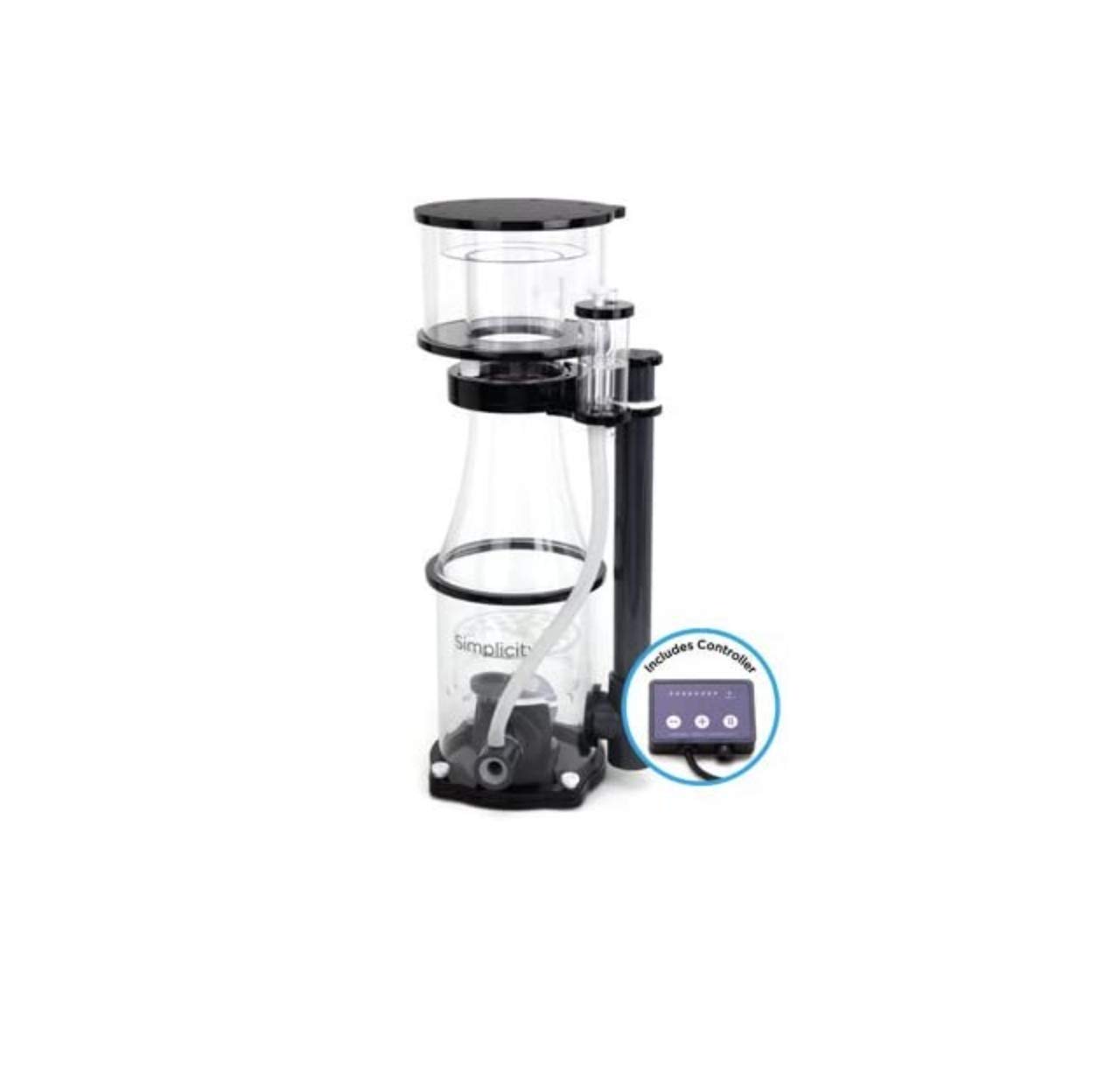
A protein skimmer is one of the most important pieces of filtration equipment in a saltwater reef aquarium. In plain terms, it works by pumping millions of tiny bubbles through your tank water — organic waste, dissolved proteins, and other pollutants cling to those bubbles and get carried up into a collection cup, where you can dump them before they ever break down into nitrates. Think of it like foam-collecting the dirt before it becomes a problem. For a reef tank housing coral and fish, stable water quality isn’t optional — it’s the difference between a thriving ecosystem and a slow crash. This guide focuses specifically on DC-pump skimmers designed to sit inside your sump (the hidden equipment compartment beneath the main display tank) and rated for systems in the 50–150 gallon range — the sweet spot where most serious hobbyists and intermediate reef builders live.
If you’re mid-build, comparing models, or trying to decide whether to size up or right-size your skimmer, this is the decision framework you need.
Why DC Pump Technology Changed the Skimmer Game
For years, protein skimmers ran on fixed-speed AC pumps. You dialed in performance manually — adjusting a gate valve, waiting 48 hours for things to settle, and hoping it held. DC (direct current) pump technology changed the calculus entirely.
A DC skimmer pump is controlled electronically, usually via a dial or digital interface, letting you tune output in fine increments without touching plumbing. That matters because skimmer performance is sensitive to small changes: a new fish addition, a coral feeding session, even evaporation levels can shift the foam column. DC pumps let you respond in real time.
The other advantages are practical and well-documented across aggregated reviews and manufacturer specs:
- Lower power consumption — typically 30–50% less wattage than equivalent AC pumps
- Quieter operation — reduced mechanical noise, which matters in open-plan rooms or office builds
- Longer motor lifespan — less heat, less friction
- Controller integration — most DC skimmer pumps accept 0–10V signals, meaning they can connect to Neptune Apex or GHL Profilux controllers for automated ramp-down during feeding cycles
Per Advanced Aquarist’s overview of protein skimmer design, the ability to ramp down pump speed during feeding (rather than switching off entirely) prevents the “micro-burst” of overdosing that crashes a skimmer’s foam column and takes hours to restabilize. For a reef system with a packed feeding schedule, that alone justifies the DC premium.
The Honest Case for Oversizing (and Its Limit)
Before comparing specific models, let’s settle the sizing debate — because this is where practitioners most commonly second-guess themselves.
The standard industry guidance, repeated consistently in the Reef2Reef community and echoed by ReefBuilders’ buying guides, is to rate your skimmer for 1.5–2x your actual water volume. A 75-gallon display with a 20-gallon sump (roughly 95 gallons total system volume) would be well served by a skimmer rated to 150–180 gallons.
Why? Skimmer manufacturer ratings are optimistic by design — they’re tested under low-bioload, lightly stocked conditions. Your heavily fed SPS or LPS reef, with 10 fish and regular coral supplements, is not those conditions.
But there’s a ceiling to the logic. A skimmer rated for 400 gallons on a 90-gallon system will produce foam so fast and aggressively it becomes nearly impossible to tune. Owners consistently report “micro-skimming” issues — the skimmer pulls water so violently that the neck floods before genuine skimmate can concentrate. The practical upper limit is roughly 2x system volume, not more.
By the numbers — sizing quick reference:
| System Volume | Recommended Skimmer Rating | Practical Budget Range (2026) |
|---|---|---|
| 50–75 gal | 100–150 gal rated | $180–$350 |
| 75–100 gal | 150–200 gal rated | $300–$500 |
| 100–150 gal | 200–300 gal rated | $450–$750 |
Four Skimmers Worth Comparing in This Range
These aren’t the only options, but they represent distinct positions in the mid-range market — different design philosophies, different price points, and different tradeoffs. All four are in-sump, DC-pump units available through major aquarium retailers as of mid-2026.
Bubble Magus Curve 9 Elite
The Curve 9 Elite is the accessible entry point to the DC in-sump category. It uses Bubble Magus’s SP3000 DC pump and a needle-wheel impeller design — the needle wheel creates micro-bubbles by physically shredding air as it enters the pump, rather than relying on air injection venturi systems. Manufacturer specs rate it for systems up to 250 gallons.
Owners in long-run reviews consistently note that the Curve 9 Elite breaks in relatively quickly (24–48 hours rather than the 5–7 days some skimmers require) and produces dark, wet skimmate under normal reef bioloads. The build quality is honest for the price, though reef community feedback on Reef2Reef flags the collection cup as a friction-fit design that benefits from silicone grease at the O-ring to prevent micro-leaks over time.
Best for: 75–120 gallon mixed reef systems on a disciplined budget. If you’re building out a first serious sump and don’t want to over-invest before you’ve dialed in your bioload, this is a defensible anchor.
Watch out for: The pump’s digital dial interface is functional but not elegant — adjustments require patience, and the display isn’t readable in low light. Not a dealbreaker, but worth knowing.
Reef Octopus Classic 150-INT
Reef Octopus has a long track record in the skimmer market, and the Classic 150-INT sits at the intersection of proven design and genuine DC refinement. The 150-INT uses a Reef Octopus VarioS pump — a DC pump that supports both manual dial control and 0–10V controller integration out of the box.
Published specs rate it for systems up to 200 gallons. Across aggregated reviews and community discussion, the pattern is consistent: this skimmer is praised specifically for stable operation over long periods. It doesn’t require constant micro-adjustment. Reefers who’ve run it for 12–18 months note that once dialed in, it stays dialed in — even as bioload fluctuates through normal tank growth.
The body diameter and footprint are worth noting: the 150-INT requires a minimum sump section of roughly 8 x 8 inches and a water depth between 7 and 9 inches to operate correctly. Per Reef Octopus’s published spec sheet, straying outside that water depth window significantly degrades skimming efficiency.
Best for: 90–150 gallon reef systems where long-term stability matters more than the lowest possible entry price. Operators managing a reef for a client — hospitality or medical office context — will appreciate a skimmer that doesn’t demand weekly babysitting.
Watch out for: The price premium over the Bubble Magus is real. Expect to pay roughly $100–$150 more for the 150-INT at current (mid-2026) retail. Whether that delta buys enough stability to matter depends on your management bandwidth.
Skimz Monzter SM163
Skimz is less widely known outside dedicated reef forums, but Coral Magazine’s DC pump technology roundup flagged the Monzter line as a genuine performer that punches above its visibility. The SM163 uses a Skimz DC pump with selectable flow rates via a 5-step dial, rated for systems up to 220 gallons.
The distinguishing design feature is the wide body cone neck — a broader, gently tapered neck compared to the narrower cylinder on the Reef Octopus. In practice, owners report this makes the SM163 more forgiving when foam production surges (after a large feeding, for example) — the wider neck slows the climb and reduces overflow events. For reefers who run aggressive feeding regimens for LPS corals or fish-heavy systems, this is a material advantage.
Build quality is solid; the acrylic is thick, the pump fits securely, and the collection cup threads are clean. The SM163 requires 7.5–10 inches of sump water depth.
Best for: 100–150 gallon systems with higher bioloads — fish-heavy displays, aggressive coral feeding, or systems still being dialed in. The forgiving foam column geometry reduces the number of “skimmer overflow at midnight” incidents that haunt new reef builds.
Watch out for: Skimz’s after-sale support and parts availability is thinner in North America than Reef Octopus or Bubble Magus. If a pump fails out of warranty, sourcing a replacement will take longer.
Deltec SC 1455
Deltec is the premium anchor in this category. Made in Germany, the SC 1455 carries a price point that’s roughly double the Bubble Magus and meaningfully more than the Reef Octopus — and the build quality reflects it. The SC 1455 uses a Deltec DC pump with continuous electronic adjustment, rated for systems up to 250 gallons.
The proprietary design focuses heavily on contact time — the amount of time water and bubbles interact before foam rises to the collection cup. Per Advanced Aquarist’s skimmer design analysis, contact time is one of the primary variables determining organic extraction efficiency, and Deltec’s body geometry is specifically engineered around maximizing it. Operators in long-run reviews consistently describe the Deltec as producing drier, more concentrated skimmate than equivalently rated skimmers — meaning the collection cup fills more slowly, and each dump contains more actual waste per unit of water removed.
For commercial installations (hotel lobby displays, medical office feature reefs) where maintenance visits are monthly rather than weekly, that characteristic has real operational value. Less frequent cup dumping, more consistent extraction — it reduces the window for organic breakthrough.
Best for: 100–150 gallon premium SPS or high-complexity reef builds, and any installation where maintenance labor cost is a real consideration. If your total system investment exceeds $5,000–$8,000 in equipment and livestock, the Deltec’s price-to-performance case tightens considerably.
Watch out for: At this price tier, budget-conscious builders will find the value argument difficult to rationalize unless the operational benefits (drier skimmate, lower maintenance frequency) are directly relevant to their use case. For a personally managed home reef, the Reef Octopus covers most of the functional ground at roughly half the cost.
The Decision Rule: If X, Then Y
Here’s how to cut through the comparison fatigue:
If you’re running a 50–100 gallon mixed reef on a build budget under $350 and will be tuning it yourself weekly → Bubble Magus Curve 9 Elite. Proven, accessible, honest value.
If you want set-it-and-forget-it stability on a 90–150 gallon display and don’t want to think about skimmer adjustment more than once a month → Reef Octopus Classic 150-INT. The DC VarioS pump and long-run reliability reports make it the default recommendation for this range.
If your system is bioload-heavy — lots of fish, aggressive coral feeding, or still finding its baseline — and foam overflow is your biggest operational fear → Skimz Monzter SM163. The wider neck geometry is genuinely forgiving in ways that matter for active, messy reefs.
If you’re speccing a commercial installation, a premium SPS build over $5,000, or a system where maintenance frequency needs to be minimized → Deltec SC 1455. The efficiency and build quality justify the premium when operational context demands it.
One final note on installation: regardless of which model you choose, every manufacturer cited in this guide — and the broader consensus in Practical Fishkeeping’s protein skimmer overview — agrees that skimmer break-in takes time. Expect 5–7 days of unstable, overflow-prone foam before the skimmer body cures and performance stabilizes. Don’t make tuning decisions in the first week. Give it time, then calibrate.