If you’ve just set up — or are about to set up — a reef aquarium with a sump (a separate filtration chamber hidden in the cabinet below the display tank), the return pump is one of the most quietly important decisions you’ll make. The return pump is the heart of the whole system: it pulls water out of the sump and pushes it back up into the display tank, keeping everything circulating. Get the sizing wrong and you’re either starving your tank of flow or running an oversized pump that turns your sump into a washing machine. This guide walks through how to calculate the flow you actually need (not just what the box claims), what “head pressure” means and why it shrinks your pump’s real-world output, how DC controllable pumps differ from older fixed-speed models, and how to match all of this to sump sizing. By the end you’ll have a clear framework — and a direct decision rule — for your current build.
What Head Pressure Is, and Why Your Pump’s Box Number Is Almost Always Wrong
Every return pump is sold with a flow rating — something like “2,000 GPH” (gallons per hour). That number is measured at zero resistance: the pump sitting flat, pushing water horizontally with no lift, no bends, no pipe friction. In a real reef system, you have none of those conditions. Your pump is lifting water from the sump (which sits inside the cabinet) up through PVC pipe into a tank that might be 18–36 inches higher. Then add pipe elbows, a check valve if you run one, a gate valve for throttling, and the internal resistance of any spray bars or returns you’ve added. Every one of those elements costs you flow.
The industry term for this resistance is head pressure, measured in feet of head. One foot of head equals roughly 0.43 PSI of back-pressure on the pump. A pump rated at 2,000 GPH at 0 feet of head might only deliver 1,100–1,300 GPH by the time water reaches the surface of your display tank at 4 feet of vertical rise — and that’s before accounting for pipe bends.
The standard rule of thumb, cited consistently across Advanced Aquarist’s plumbing guides and Reef2Reef’s pump-sizing threads: plan for roughly a 35–50% reduction in rated flow for a typical under-tank sump setup with moderate plumbing. If you need 1,200 GPH of return flow, you’re shopping for pumps rated 2,000–2,400 GPH.
Running the Head Loss Math
The calculation is straightforward once you have the pump’s performance curve (most brands publish this):
- Measure vertical rise — distance from water surface in sump to outlet in display tank (e.g., 36 inches = 3 feet of head).
- Add equivalent feet per fitting — each 90° elbow adds roughly 1–2 feet of equivalent head; a check valve adds 3–5 feet; 10 feet of 3/4” PVC pipe adds about 1 foot.
- Total system head — add all values together.
- Find your pump’s output at that head — locate that total on the pump’s published performance curve to get real GPH.
A build with 3 feet of vertical rise, two elbows, a gate valve, and 6 feet of pipe might easily hit 7–9 total feet of effective head. Run that against the performance curve rather than the box number, and your pump selection changes significantly.
By the numbers
- 1 foot of vertical rise ≈ 0.43 PSI back-pressure on pump
- Each 90° elbow (3/4” PVC) ≈ 1.5 equivalent feet of head
- Check valve (swing type) ≈ 4–6 equivalent feet of head
- Target turnover rate for mixed reef: 5–10× display tank volume per hour through return alone (powerheads/wavemakers supplement this separately)
DC Controllable vs. Fixed-Speed Return Pumps: Where the Decision Actually Lives
Older return pumps used AC motors — they ran at one speed, full power, all the time. You throttled them with a gate valve, which is mechanically like trying to regulate your car’s speed by partially blocking the exhaust. It works, but you’re wasting energy as heat and stressing the motor.
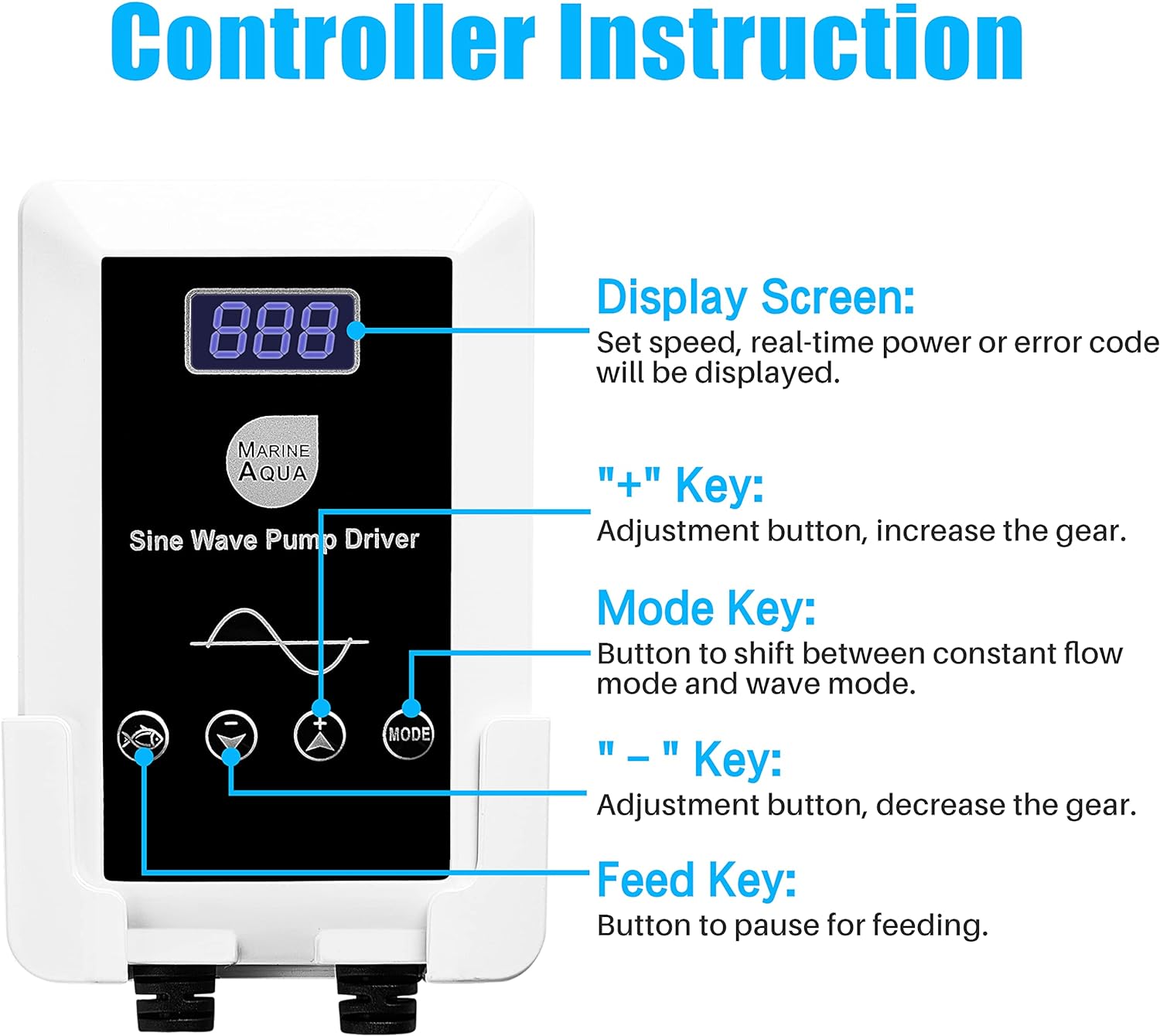
DC (direct current) controllable pumps use a brushless motor paired with an external controller that lets you dial output from roughly 20–100% of rated flow. The practical advantages for reef keepers:
- Feed mode / maintenance mode: drop the pump to 20–30% with one button press so you’re not fighting full-return flow while target-feeding corals or doing equipment maintenance.
- Soft-start: the pump ramps up gradually at power-on, reducing water hammer (the pressure spike that can loosen fittings over time).
- Energy efficiency at partial load: a DC pump running at 60% uses significantly less power than an equivalently rated AC pump throttled to the same output with a valve. Reef Builders’ analysis of DC return pump wattage data consistently shows 30–45% lower power draw compared to AC alternatives at matched actual flow rates.
- Controller integration: models from brands like Ecotech Marine (Vectra series), Jebao (DCP series), and Reef Octopus (various DC models) can accept external signals from reef controllers like the Neptune Apex or GHL ProfiLux, allowing the pump to slow automatically during feeding, storms, or user-programmed low-flow periods.
Where fixed-speed AC pumps still make sense: lower-budget builds where the price delta matters (a quality DC pump costs $120–$400 vs. $40–$120 for comparable AC flow), or temporary setups and quarantine systems where integration and tunability aren’t priorities.
The honest tradeoff: DC pumps have more electronic components, which means one more failure point. Across aggregated owner reports on Reef2Reef and reef-focused forums, DC pump failure modes tend to be controller-board related rather than motor death — and most manufacturers sell replacement controllers separately, which can extend pump life substantially.
Sizing Your Sump to Match Return Pump Flow
This is where intermediate builders most often under-engineer. The sump isn’t just a place to hide equipment — its chamber sizing has to accommodate two critical scenarios: normal operation and power-cut drain-back.
Drain-back is what happens when the power goes out. Water in the pipes above the sump drains down by gravity until the siphon breaks (usually at the bulkhead or overflow inlet). If your sump’s return section isn’t large enough to absorb that drain-back volume without overflowing, you have water on the floor. Coral Magazine’s sump design coverage recommends calculating drain-back volume for every build: measure the internal volume of all pipes between the pump outlet and the display tank overflow, and ensure the return chamber has at least that much headroom (air gap between normal operating level and the chamber rim).
Return chamber sizing guidelines (based on published sump-design best practices from Advanced Aquarist and Coral Magazine):
- Return chamber should hold the pump fully submerged at minimum water level and absorb drain-back without overflowing.
- For a 75-gallon display with a typical 1” return line running 4 feet vertically, drain-back is roughly 0.5–1.5 gallons — manageable in most standard sumps.
- For larger systems with 1.5” or 2” return lines, drain-back volume can reach 2–4 gallons. Practical Fishkeeping’s plumbing guides recommend sizing the return chamber to at least 150% of calculated drain-back for margin.
Sump total volume rule of thumb: plan for sump volume at 20–30% of display tank volume. A 120-gallon display pairs well with a 25–40 gallon sump. Larger sumps provide more water volume (stability buffer for chemistry and temperature), more equipment real estate, and more drain-back capacity — all genuine benefits for reef systems.
Matching Pump GPH to Overflow Capacity
One failure mode that doesn’t get enough attention: the return pump outpacing the overflow. Your overflow (the drain from the display tank into the sump) has a rated maximum flow capacity — typically printed on box-store overflow kits and custom Coast-to-Coast overflow specs. If the return pump pushes more water up than the overflow can drain down, the display tank floods.
Standard Durso-style standpipes in a single 1” bulkhead handle roughly 300–600 GPH before they start struggling with noise and air-lock. Bean Animal-style three-pipe overflows (a popular DIY approach) in a 1.5” configuration can handle 1,000–1,500 GPH quietly. Match your pump selection to your overflow’s actual capacity, not just your tank volume.
Practical Decision Rules: If X, Then Y
If you’ve made it this far, here’s how to collapse all of this into a clean framework for your current build:
If your display tank is under 75 gallons and you’re on a budget: an AC fixed-speed pump rated at 2–3× your actual flow target (after head loss math) is defensible. Brands like Sicce and Aquatop offer reliable mid-range AC options. Use a gate valve to throttle and accept the minor energy inefficiency.
If your display tank is 75–150 gallons or you’re running a mixed reef with SPS corals: a DC controllable pump is worth the price premium. The ability to integrate with a controller, run feed mode without manual intervention, and tune flow precisely matters more as system complexity grows. Ecotech’s Vectra M1 and M2, Reef Octopus’s DC series, and Jebao’s DCP-series pumps are consistently well-reviewed by owners in this range for reliability and controller compatibility.
If you’re building a sump from scratch or commissioning a custom build: size the return chamber for at least 150% of calculated drain-back, validate that overflow GPH capacity exceeds your pump’s real-world output at system head, and spec a DC pump with Neptune Apex or GHL ProfiLux integration if the rest of your system already runs on one of those controllers.
If your pump feels underpowered after install: before buying a replacement, check the performance curve at your actual system head — many “underpowered” pumps are simply working against more head than the builder calculated. Adding a second return line (parallel plumbing) cuts head loss and increases effective flow without a new pump.
If your sump is loud or gurgling: the issue is almost always overflow capacity or standpipe design, not the return pump itself. Reef2Reef’s extensive troubleshooting threads on Bean Animal and Herbie overflow systems are the right starting point for that diagnosis.
The return pump is one of those pieces of gear that rewards slowing down and doing the math once rather than swapping equipment twice. Run your head pressure numbers, check your overflow rating, size your return chamber with drain-back in mind, and the rest of the decision falls into place cleanly.